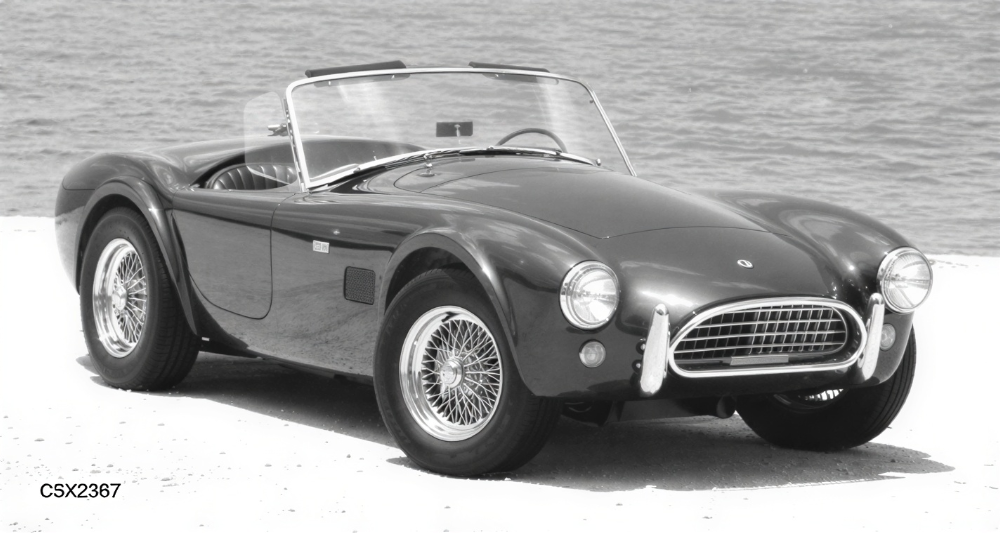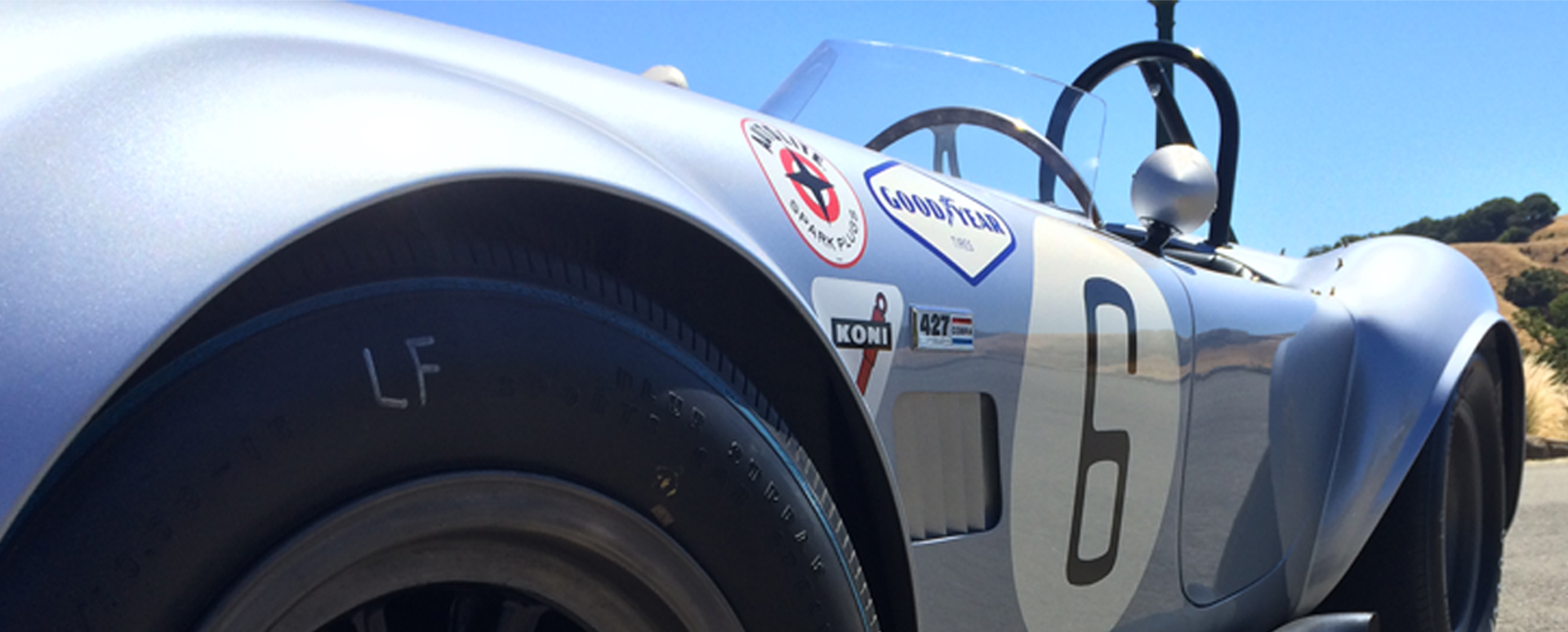
The Cobra wasn’t born in a flash of lightning and a clap of thunder, sitting there when the dust cleared just waiting to take on the sports car world. It was a longer and more involved process which actually had its roots back in the 1950s, when Shelby was racing sports cars. After seeing some British and Italian sports cars close up and the small specialty shops where they were made, Shelby began to think about building a sports car of his own. An American car. However, at this point it was little more than one of those “some day...” projects we all think about when our body is in neutral but our mind is racing.
Shelby had worked hard to achieve an excellent reputation as a driver in the United States, so the natural
progression was to move on – and up – to Europe. He went there because it was where the most prestigious sports
car races were run, and it was there where racing legends were made. It was also there where real sports cars
were built. In the late 1950s, Europe was the center of the sports car racing universe. If you wanted to assume
a prominent position within that universe you went to Europe. It was that simple.
Shelby’s driving career was like a skyrocket. His first race was in 1952, in a borrowed MG-TC. A mere two years
later he turned professional. Well, not in the current sense of the word. Back then it was considered crass and
bad form for a sports car driver to actually accept money to drive. This was a gentleman’s sport where you raced
for pewter trophies and silver trays; there was no such thing as cash awards to the winners. As a result of this
attitude, most sports car racers tended to be wealthy aristocrats or successful businessmen. Many had been
pilots during WWII and driving nimble sports cars around a twisting road course was as close as they could get
to once again piloting a fighter through the skies, engaging in dogfights.
The blue collar types had their place in the racing world, and that was in jalopies, stock cars and open-wheeled single seaters that raced around oval tracks. The top of that heap was Indianapolis, where there was a lot of money and where sponsors paid to have their name painted on the side of a car. If sports car drivers were polo players, circle track drivers walked behind a horse pulling a plow.
THE NAME CAME TO HIM IN A DREAM
How the Cobra got its name is a typical Shelby story. He customarily slept with a note pad and pencil on his
night table so he could jot down things he thought of at night, because he knew he’d forget them by morning.
When the first car arrived from AC Cars, Shelby still had no idea what he would call it. It was shipped with
a round “AC” badge on the nose and trunk. When it was first shown to the press in bare aluminum the “AC”
badge was removed from the nose and “Shelby” was hand-lettered.
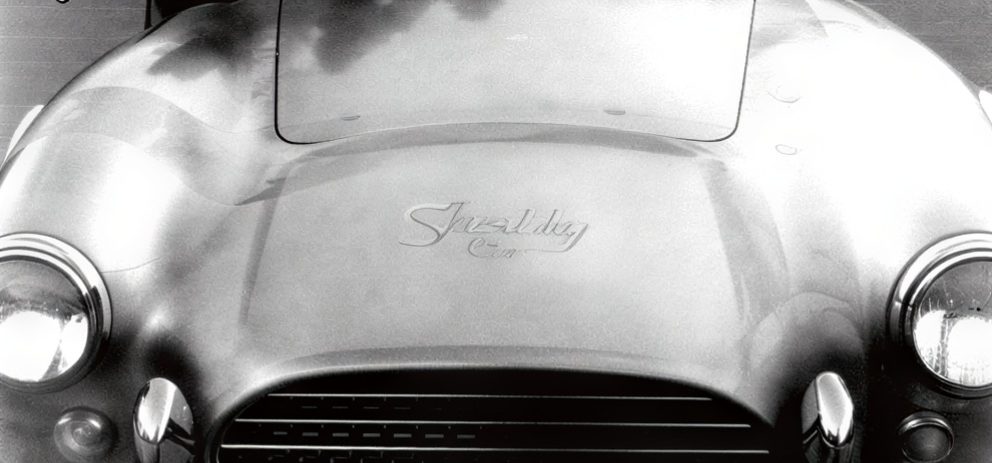
One morning shortly thereafter, Shelby awoke to find the word “Cobra” scrawled on his note pad. He didn’t recall writing it, but it was sure enough his handwriting. The Cobra name had come to Carroll Shelby in a dream but the now famous, round Cobra logo had a slightly more involved birth.
Initially there was some confusion over the car’s name. Pete Brock recalls that at the very beginning, Shelby's intention was to call the car the "Shelby" and he didn’t want any emblems on it at all. The name “Cobra” had not yet appeared. Ford was not overly excited about having its name too closely linked with an unknown quantity, so it was entirely satisfied with only a "Powered by Ford" badge on each fender. AC, on the other hand, attempted to attach their name to the car from the very beginning – much to Shelby's annoyance.
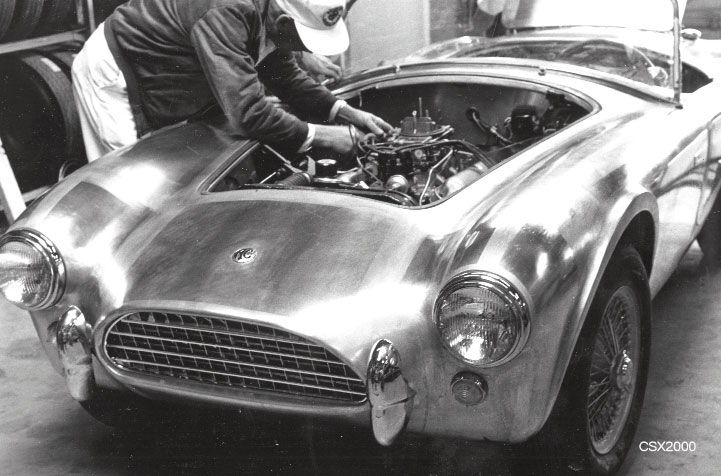
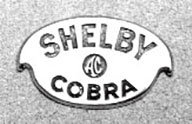
With the new project only just unfolding, Shelby didn't want take the chance of ruffling the staid and proper British company’s plumage. Just about the time CSX2000 was completed he came up with the name “Cobra,” so AC Cars took the liberty of creating a badge that said “Shelby AC Cobra” and installing it on each car just before shipment to the U.S.
When Shelby saw the emblems AC had created he didn’t like them, but he knew the car had to have something. He called a local die cast shop he had picked out of the yellow pages and told them to make an badge for his car. He wasn’t specific; he just told them it had to have a cobra snake and the car’s name.
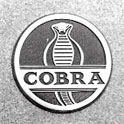
They came up with the early round emblem which featured a hooded snake head and the letters "C-O-B-R-A." This has come to be known as the “flat-headed snake” by Cobra enthusiasts. The emblem’s diameter was made purposely large so that it would cover the holes AC Cars drilled in each Cobra’s nose and trunk lid when the new badges were affixed at Shelby American. The first couple of batches of cars were delivered to their owners with the original “AC-Shelby-Cobra” badges because the flat-headed snake badges had not yet been delivered. As soon as the new round Cobra emblems were received they were used in place of AC’s badges.
When Peter Brock first saw the new Cobra logo he went ballistic. It was a crude design, graphically, and he realized that it did not befit the Cobra’s image. Brock knew the Cobra deserved better. Shelby, however, was more interested in producing the cars themselves, and his disinterest in this small detail only made Brock angrier. A two-hour shouting match soon ensued and when Shelby realized how serious Brock was about the car having a respectable badge on its nose and trunk he finally relented, telling Brock to “Go ahead and redesign it.” Brock promptly did and the result is the smaller, but now familiar red, white and blue on chrome round Cobra logo that was used on all later small block Cobras and all big block cars.
In a driving career that spanned only eight years, Carroll Shelby won three national sports car championships and established a record of 19 straight victories as well as winning numerous races in Europe—including a Formula One victory. In 1956 he was named Sports Illustrated’s “Sports Car Driver of the Year,” and the New York Times accorded him similar recognition in 1957 and 1958. In 1959, co-driving a factory Aston Martin entry with Englishman Roy Salvadori, the two won the prestigious 24 Hours of LeMans. All skyrockets eventually reach their maximum trajectory and then fall back to earth. Carroll Shelby was no exception.
Shelby’s career as a driver was black-flagged in 1960, cut short by a heart problem which had existed for as long as he could remember. In fact, in some of his last races he drove with a nitroglycerine pill under his tongue. In 1960, when his doctor told him he could no longer race, he settled in Southern California, the cradle of automotive civilization in the U.S. He was able to negotiate a contract with Goodyear to distribute their racing tires on the west coast. He also started the first high performance driving school in this country, and began casting about for other automotive projects. These were, however, only temporary things to help pay the bills until the sports car occupying his mind took shape. All he needed was a chassis. And an engine. As the saying goes, “If I had some eggs, I could have a ham and egg sandwich, if I had some ham.”
The ham and eggs came together at almost the same time. Shelby heard a rumor that proved to be true: the Bristol Aeroplane Company was going out of business in England and as a result, AC Cars, Ltd., manufacturer of the aluminum-bodied, two-seat AC Ace sports car, was losing its engine supplier. In this country, Ford had just unveiled a small, lightweight V8 engine. The light bulb that clicked on over Shelby's head was a 400-watter. He called on AC Cars at exactly the right time because they were just then wondering how they were going stay in the business of building cars without engines. Also unbeknownst to Shelby, Ford was on the edge of a vortex that would be called “Total Performance”—probably the single most ambitious competition program in the history of the automobile.
It bore the stamp of a young, hard-charging Ford executive named Lido A. Iacocca and it would eventually propel Ford into virtually all forms of racing throughout the mid-1960s. Unquestionably the best book ever written about Ford’s racing exploits is “Ford – The Dust and the Glory” by Leo Levine in 1968.
“History would record that in 1966, Fords or Ford-powered cars: Won the World Manufacturers Championship with
triumphs at Daytona, Sebring and LeMans, with the latter being the first 24-hour victory here for an American
vehicle. Won the Indianapolis 500, dominated the remainder of oval track, single-seater racing in this country,
and was the engine used by the USAC Champion.
Were the main source of engines for international Formula II and Formula III racing, and dominated the latter
(the next year, Ford also collaborated in the construction of the fastest Grand Prix car the sport has ever
seen).
Were a major factor in international rallying.Made their presence felt in big-time drag racing.Won the
Trans-American Sedan ChampionshipWere, as usual, one of the major factors in NASCAR and USAC stock car racing.”
A little known fact is that long before the Cobra snaked its way into Shelby’s psyche he briefly had the ear of Ed Cole, one of the powers near the top of the General Motors pyramid. Shelby’s idea was to build a Ferrari-like sports car using a Corvette V8 engine and chassis and a body built by the Italian coachbuilder Scaglietti. Shelby convinced Cole to give him three complete Corvette chassis and engines in 1957 and they were shipped to Scaglietti’s shop in Modena, Italy. The plug was pulled when he received a midnight phone call in Modena from Cole. Zora Duntov had caught wind of Shelby's end run, and to protect his fledgling Corvette he blew the whistle on Shelby to some of GM's top management. They, in turn, immediately passed the word to Cole that one sports car was quite enough for Chevrolet, thank you. Cole's instructions to Shelby were succinct: “You never saw those cars. Forget them.”
Shelby may have forgotten those three particular Corvettes but the idea for a sports car of his own manufacture, powered by an American V8, was never far from his mind. As a driver he had traveled throughout Europe and used the opportunity to get an up-close look at the various sports car manufacturers. He saw that most of them were small specialty shops. He also realized it would not be financially feasible to start with a clean sheet of paper and build an all-new car of his own design. He would have to begin with something that already existed, adding an engine and making other modifications that would be required.
Thus was the Cobra born, and in 1961 little did Carroll Shelby know that he was destined to become Ford’s figurehead in international sports car racing with a car of his own manufacture. It would have a Ford engine and its name would soon become synonymous with lightning acceleration.
Shelby American, Inc. was incorporated soon thereafter. And right after that, Shelby signed a contract with AC Cars to build his Cobra. A lot of people think those first Cobras were simply AC Aces with Ford 260 cubic-inch engines and Borg Warner T-10 4-speed transmissions bolted into them, but in actual fact the original AC chassis and suspension were only starting points. Virtually everything had to be strengthened or redesigned to handle the Ford V8's additional power. The AC Ace’s 6-cylinder put out 135 horsepower. The street Cobra’s V8 was rated at double that, and the racing versions produced almost triple!
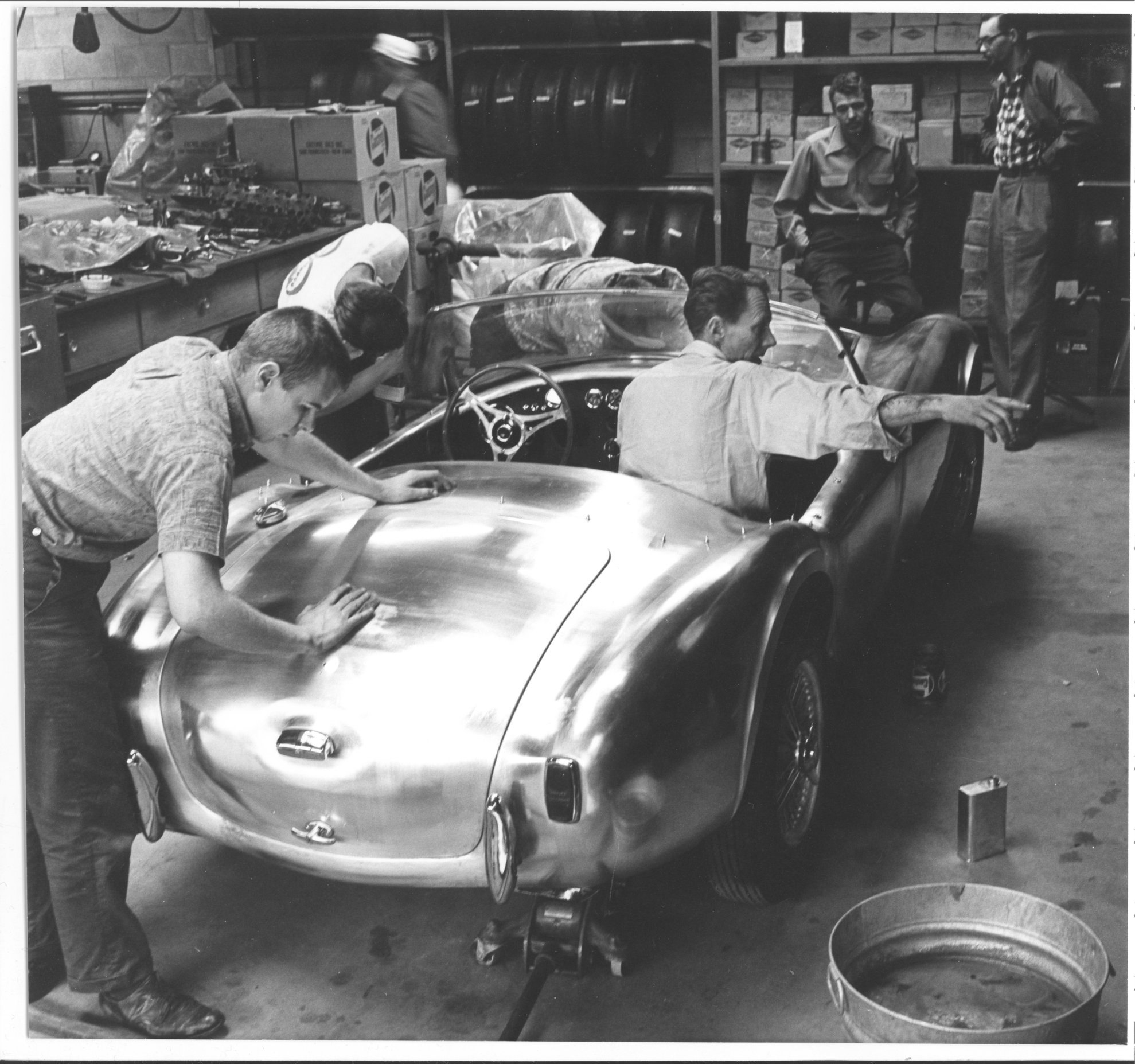
The Cobra also had a wider front and rear track. Although it looked somewhat like the original AC Ace at first glance, the Cobra had subtle differences that gave it a much smoother appearance. Cobras also had different cooling systems and larger, four-wheel disc brakes. Shelby’s “new” car might have resembled AC’s “old” one, but there was a world of difference under the skin. This became startlingly evident when the Cobra’s clutch was released and its accelerator depressed.
The very first Cobra, given the serial number CSX2000, was shipped by air from England to New York on February 2, 1962. Upon arrival in New York the car, without an engine or transmission, went through customs and was immediately forwarded, again by air, to Los Angeles. It was picked up at the LA airport the minute it arrived. Less than eight hours later at Dean Moon’s shop in Santa Fe Springs, a blue collar town east of Los Angeles, the Ford 260 Hi-Performance engine and four-speed Borg Warner transmission were installed and Shelby and Moon were tearing through the flat, dusty oil fields outside of town. Shelby’s car was even faster than he had expected in his most optimistic predictions. In a word, he was elated.
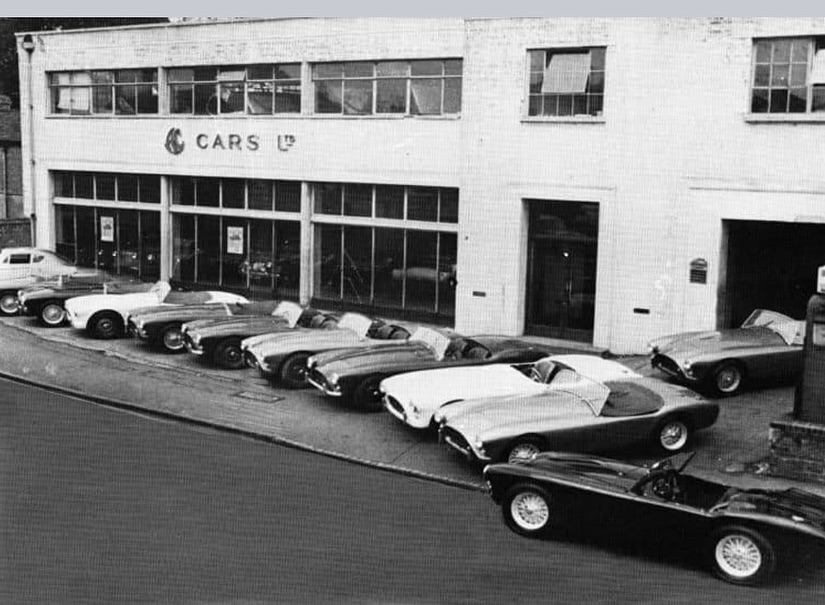
AC Cars, Ltd. was the oldest continually operated automobile manufacturing company in England. That was about to come to an end when they lost their engine supplier. Shelby’s knock on the door turned things around quickly.
At this point Shelby realized he had all of the necessary ingredients for the recipe. All that was left was to refine the amounts. CSX2000 was essentially an AC Ace chassis. It had inboard rear disc brakes, lightweight brackets and it needed strengthening everywhere. A list of changes was made and sent to AC Cars with the order to modify the chassis as indicated and commence production.
Moon’s shop consisted of a small building with a handful of garages
attached. Shelby required more space and exactly what he needed just happened to be available at 1042 Princeton Drive, in Venice. Lance Reventlow had been building his Scarab sports cars in an unassuming commercial brick building. When he folded his business Shelby took over the lease. Included were all of the machines, tools, benches and even some employees: shop manager Warren Olsen, bookkeeper (and Olsen’s wife) Helen, and Phil Remington.
“Rem” has been variously described as a mechanic, fabricator and engineer but he is an engineering genius who solved every problem that cropped up on the Cobras – both the production cars and the race cars. Remington could make something faster than it took for someone to describe what they needed, no matter if it had to be machined out of a solid piece of steel or aluminum, welded, brazed or pounded out of a scrap of sheet aluminum. He proved to be Shelby’s secret weapon and was more responsible for the Cobra’s winning race record that anyone else – drivers included.
“Its acceleration can only be described as explosive.” – Sports Car Graphic, May, 1962. “When the Cobra is certified for production sports car racing, a fox will have been dropped among the chickens.” – Car Life, June, 1962. “The hair-curling level of performance the Cobra provides will certainly give the ranks of big production-car racers pensive moments.” – Car and Driver, March, 1963.
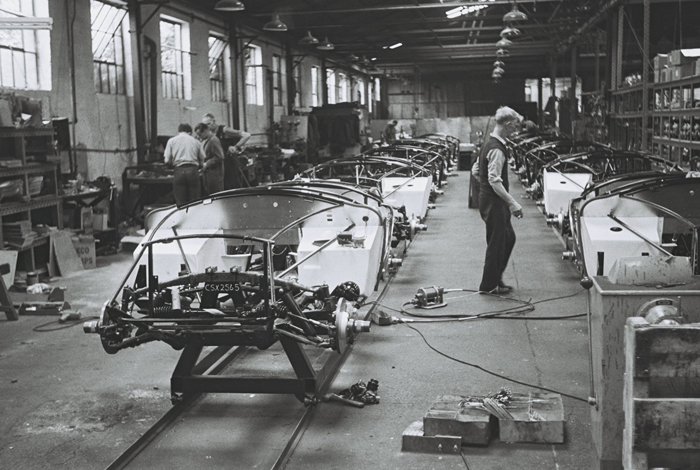
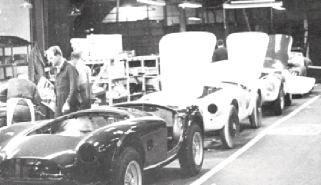
AC’s assembly line was not unlike other small automobile manufacturers. Cars moved along on dollies from one work station to the next where parts were installed. Aside from exterior and interior colors, the street cars were all the same. Options, such as they were, were added at Shelby American prior to delivery.
Shelby wasted no time throwing gasoline on those journalistic fires. Barely was an automotive writer out from behind the wheel of the Cobra – his heart pounding, his hands shaking and his head spinning – when Shelby was whispering in his ear about the special racing version being developed which would have even more horsepower, be even faster, handle even better and stop even quicker. This, on top of the fact that the car was already light years ahead of everything else within memory. It was just too much for some writers and they had to take a few days off just to clear their heads. The Cobra was that kind of a car – you never forgot your first ride.
deemed best for viewing under fluorescent lighting – and it was shipped to New York City where it was placed in the Ford display at the April, 1962 New York Automobile Show. Dean Moon, a promoter on par with Shelby himself, immediately started bragging that the Cobra had been painted “Moon Yellow.” Everything Moon ever built was painted “Moon Yellow” and although the first Cobra had not been painted Moon’s special shade of yellow, his story stuck. After its return from New York, CSX2000 was road tested by Road & Track. They put it on the cover of the September issue with Shelby, himself, behind the wheel in a red baseball cap.
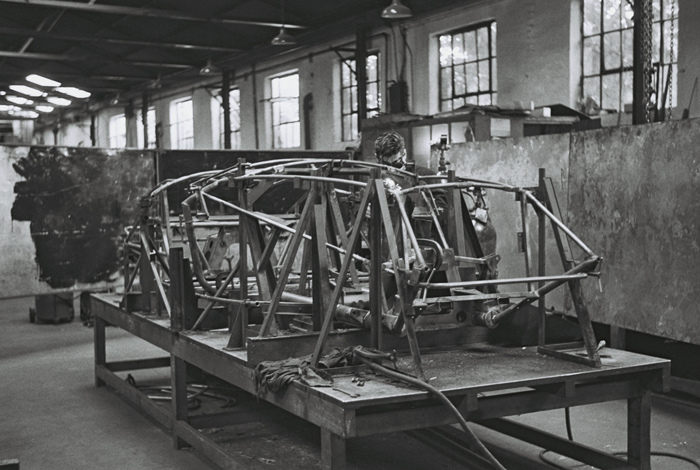
Once the chassis was completed it was set on a trolley (there were two, side-by-side at AC’s factory in Thames-Ditton) and rolled down the assembly line from station to station where the various pieces were attached.
The first Cobra – and at that precise point in time the only Cobra – was quickly painted red before it was given to another magazine to test. Then it was painted blue for yet another road test. As far as the automotive magazines knew, Cobras were rolling off of Shelby’s production line by the dozens. The illusion of a quantity of cars was necessary for the fledgling company because there were orders to take and dealers to sign up... and one car doesn’t deliver much credibility.
As Shelby began to settle into the role of manufacturer, he discovered a myriad of problems to be solved and obstacles to be overcome: sourcing and obtaining parts; completing cars as they arrived; building a dealer network; creating a marketing and advertising campaign. Cobras were shipped by boat from AC Cars without engines, radiators, transmissions or driveshafts to save on import duties, which were much higher on finished cars than on incomplete ones. And, as the ships’ crews had the habit of walking over the cargo once it was lashed down in the hold, some early Cobras required aluminum and paint work before they could be delivered to dealers.
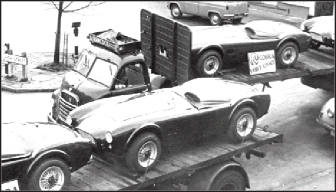
Speaking of dealers, shipping cars to them was another problem that required a special solution. In order for the entire project to get off to a smooth start, Shelby realized he needed to get completed Cobras into the hands of his first dealers as soon as possible. That meant immediately. More than a few individuals had suddenly become very interested in the Cobra, and some had even dropped hints about wanting to become Shelby’s partner. Rather than turn them off, Shelby asked some for assistance. Of course, they were only too happy to provide it.
The second and third cars, CSX2001 and CSX2002, were shipped from England by air. CSX2001 arrived in New York on May 19th and was prepared by Shelby’s East Coast Distributor, racer Ed Hugus in Pittsburgh, Pennsylvania. Hugus installed the engine and transmission. He detailed and road-tested it and then readied it for delivery. It didn’t sit in his sports car dealership for very long. In fact, it found a buyer within days. CSX2002, which was to become the first Cobra race car, was air-freighted directly to Los Angeles.
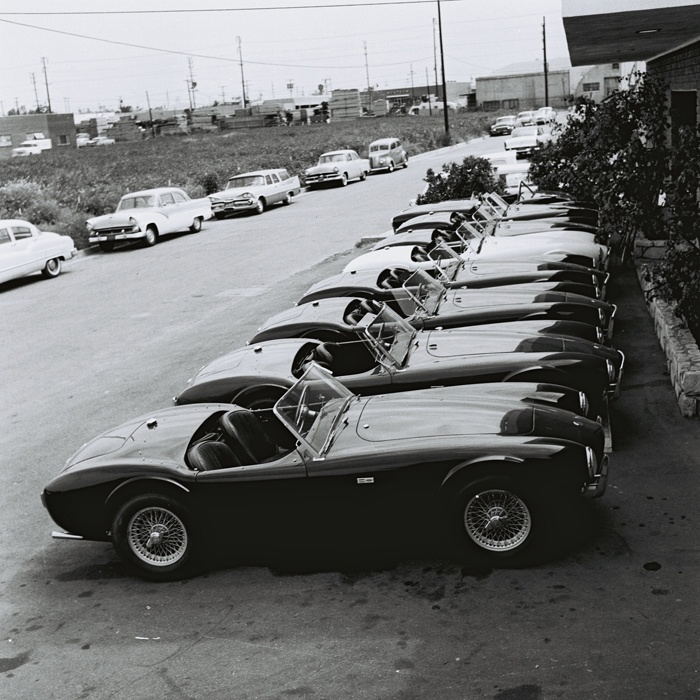
A row of completed Cobras are parked in front of Shelby American’s Venice plant awaiting shipment to
dealers.
One problem that cropped up immediately was the length of time it took for cars to reach the first dealers
who were clamoring for them. They had to be shipped from England, land in New York and go through customs,
and then get shipped to Los Angeles where they would be completed at Shelby American. They would then be
shipped to dealers, in some cases back on the east coast. Getting cars in dealers’ hands as quickly as
possible was important, so to expedite things some of the early cars stayed on the east coast. They were
actually finished by two of Shelby’s first dealers. Ed Hugus’ European Motors in Pittsburgh got 2003, 2004
and 2005. Tasca Ford in East Providence, Rhode Island got 2024, 2028, 2029 and 2034.
If the early Cobras are remembered for anything it is the continual running changes that were carried out
during their production. Initially all Cobras had worm and sector steering, 260 cubic-inch V8s with
generators, Lucas electrics, Smiths gauges, 5 1/2≤-wide wire wheels and no side vents. Two things led to the
updates or improvements that were made to the early Cobras. One was owner and dealer feedback about the cars
already sold, and the other were the inadequacies spotlighted by open competition.
As one problem was solved or an improvement made, all subsequent cars received the update and it was
incorporated into the Cobra’s standard specifications. No attempt was made to retro-fit any cars already
completed and sold prior to the change. However, it should be pointed out that cars were not always
completed and shipped from AC cars to Shelby in strict serial number order. A car with an early serial
number may reflect features common to cars with later serial numbers and still be essentially correct as
delivered. Also worth mentioning is the fact that not all updates happened at the same time. If they had,
perhaps another model or series would have been designated. But since the changes were incorporated into
production as they occurred, it often appears to the Cobra novice that no two cars are exactly alike. This
was certainly thought to be the case before the compilation of the very first Cobra Registry in 1973. At
that time it was rare for owners to communicate with other owners outside of their general area.
Running changes made during the first 200 Cobras can be put into three broad categories. Changes which increased performance – 289 engines instead of 260s, rack-and-pinion steering instead of worm-and-sector, wider wheels, numerically higher rear end ratio, etc. There were also changes which decreased the number of mechanical malfunctions or problems – larger radiators (the switch from Corvette to McCord), Ford electrics instead of Lucas, the addition of side vents, strengthening of components and the like. And there were changes dictated by a change in suppliers – for any number of reasons such as availability, quantity, cost, etc. (i.e. Stewart Warner gauges, rack and pinion steering wheel, hood and trunk emblems, etc.).
By the time the 200th car had been built Cobra production was more or less standardized. Most problems that
became apparent with the street cars had been solved and because the race cars were then being specially
built from ground zero (i.e. LeMans, FIA and USRRC cutback-door cars were specifically designated as race
cars at the time of their construction at AC Cars and built to different specifications than street cars),
it was no longer a matter of strengthening and modifying street cars to racing specifications.
As Cobra production became more standardized, options became more sophisticated. Fewer than 20 cars were
built with the Ford C-4 automatic transmission, and a special “Slalom Snake” model was offered for
autocrossing. It featured racing suspension, brake cooling scoops, magnesium pin-drive wheels, a roll bar
and a hood scoop. Windwings and sun visors were deleted. Only two were ultimately produced and sold.
The most important feature of any Cobra is its unique serial number. This is the equivalent of a show dog’s pedigree and without a valid serial number a car is worth little more than the total cost of its parts. Part of the definition of what constitutes a real Cobra are two important criteria that cannot be duplicated: the time frame in which the car was originally manufactured, and the auspices under which the car was built. If a car without legitimate ownership documents were to be built from scratch today, to absolutely original factory specifications, even though it might be virtually indistinguishable from an original Cobra it would still not be considered “genuine” because it does not meet the two criteria of date and manufacturer. The time frame is important because in order for a car to be considered an original Cobra, its construction must have taken place between December of 1961 (when the first Cobra roadster was begun) and early 1969 (when the last coil spring chassis was built). The manufacturer of record, as evidenced by each Cobra’s original Manufacturer’s Statement of Origin, was Shelby American, Inc. in California. The only exception is the group of 88 cars, serial numbered COB and COX, which were built by AC Cars in England for the European market. AC Cars, Ltd. – rather than Shelby American – was listed as the manufacturer of record for these vehicles.
The Manufacturer’s Statement of Origin, also referred to as the “MSO,” is a document created by the manufacturer which serves as the car’s title between the time its production is completed and it is delivered to the selling dealer. Each state has its own form of title, and since is not possible for a manufacturer to determine in advance which state a car may ultimately be sold in, the MSO is a universally recognized document which accompanies the car from manufacturer to dealer. When the car is registered, the MSO is surrendered to the state motor vehicle department which creates a title in its place. As such, few owners have ever seen their car's MSO because in the original sale, the dealer usually handled the initial registration.
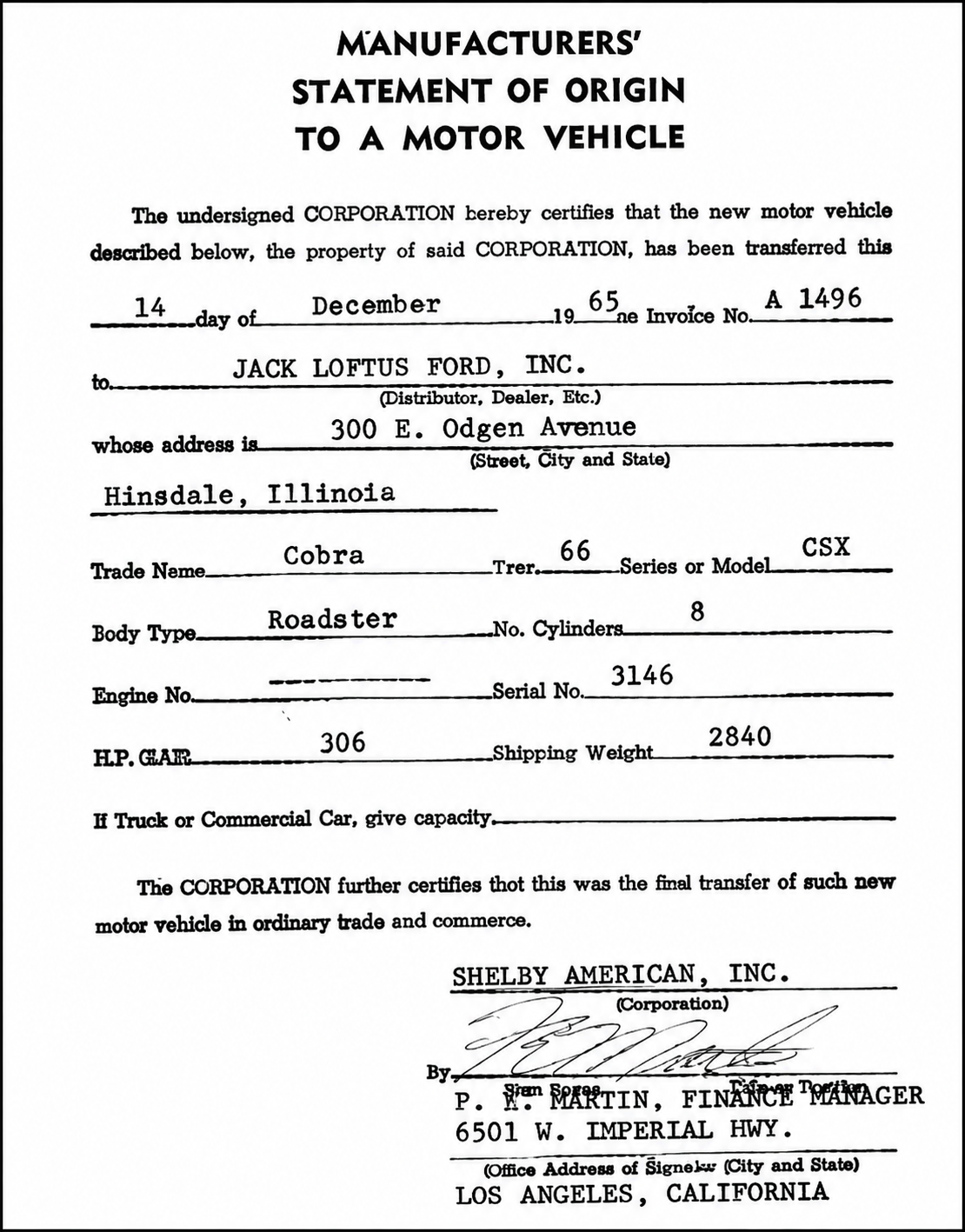
The concept of paperwork is worth expanding upon because many people confuse a car’s title with the car itself. They are convinced the two are one-and-the-same. They are not. The title is a paper document which is used to represent the car in much the same fashion as a deed represents a piece of property. Both are only paper representations of the actual thing. Titles are created by state motor vehicle departments for legal and administrative purposes. They describe the motor vehicle and represent the motor vehicle but they are not the motor vehicle. If someone were to have possession of a title but no actual car, having that title does not give them the right to create a car and then give it the serial number on that title. Different states have different laws regarding this. Distilled down to dollars and cents, this means that a Cobra which has a legitimate title may be worth $450,000 while a car that was created from nothing more than a title – commonly referred to as an “air car” because it was created out of thin air – may be worth less than a fifth of that.
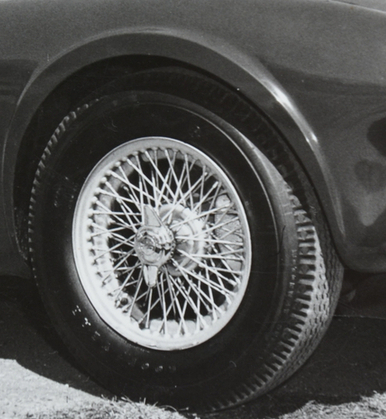
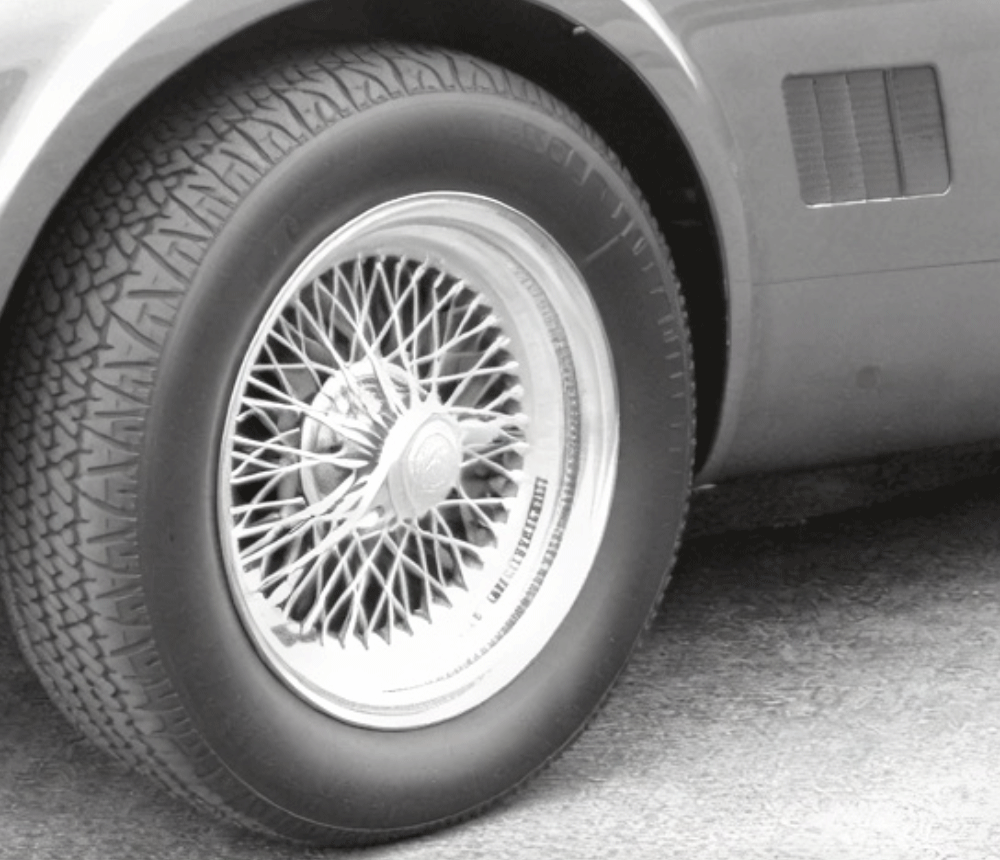
so they used a “C” prefix, which many people mistakenly assume stands for “Cobra” or “Carroll.” The letters might have fit but this was actually nothing more than a coincidence. AC was simply continuing the numbering system they had been using since 1954. The second letter in the prefix, an “S,” did stand for Shelby and the third letter, “X” denoted the cars were left-hand drive, for export. Shelby American’s contract allowed AC Cars to build their own version of the Cobra for sale in the United Kingdom and Europe. These cars were built as right-hand drive models and (with a couple of exceptions) were given “COB” prefixes (CObra Britain). Left-hand drive models were given “COX” prefixes (CObra eXport). The sequential four-digit production number on these domestic Cobras began with a “6.”
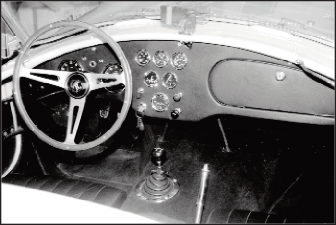
These people had fairly high incomes, belonged to country clubs and were not interested in street racing or hot-rodding their cars. They saw it as a sports car, not a muscle car. Once Cobras became used cars their value dropped. Second and third owners were younger, less affluent, and more likely to modify the cars. Around 1972 interest in Cobras began to increase. This was primarily due to the fact that the 1970s yielded a performance blight. Hostile insurance companies and strict federal regulations combined to kill the muscle car as it had come to be known. The performance tide went out and left the Cobra as the high water mark. No other car even came close. As a result the Cobra legend got a jump-start.
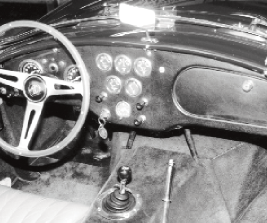
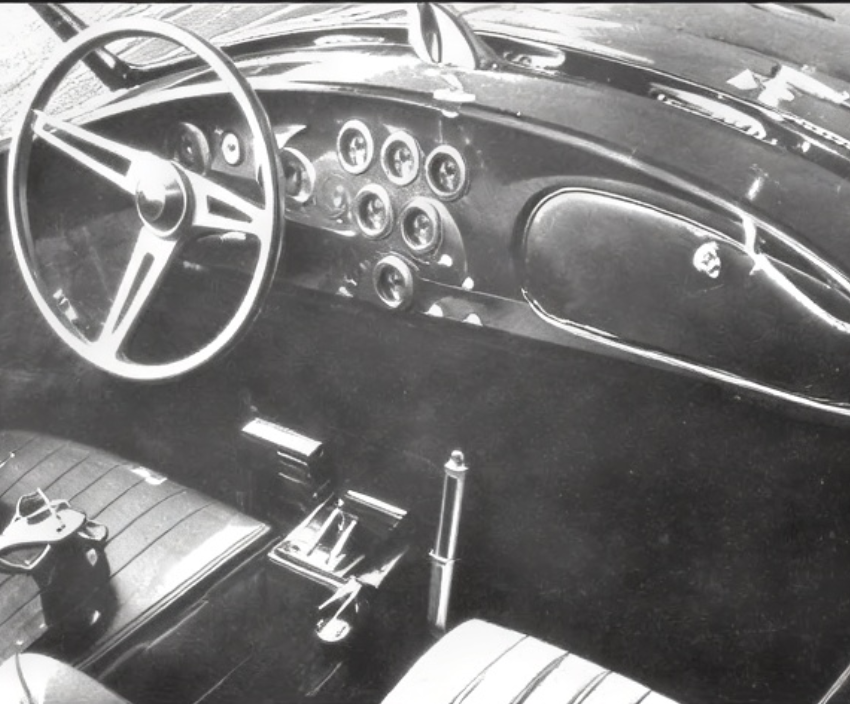
A C4 automatic transmission was optional; Mustang floor shift was used. Less than 30 were made, all near the
end of production.
A hardcore group of Cobra enthusiasts slowly grew and through shared information about parts sources, the cars
began to be restored. Interest spawned owner’s organizations and they, in turn, brought the cars back into the
public spotlight. This was fairly easy to do because there was little on the automotive scene throughout the
late 1970s that could compete with a Cobra. As interest increased so did Cobra values. Between 1970 and 1975
prices more than doubled (from about $4,000 to $10,000). The upward spiral continued and by the end of the
1970s, small block Cobras were in the $40,000 neighborhood. Prices continued to escalate and by the mid 1980s an
average Cobra was into the $100,000 range. And everyone knows what happened at the end of the 1980s: prices
doubled again, and then again – to the point where 289 street cars were being advertised for $250,000 and people
with 427s were turning down $500,000 offers. Cobras with race history went off the scale.
Some of the prices were artificially inflated by dealers and brokers, and the blast of cold air that was the 1990s returned things to a more realistic level – $150,000 and $250,000 for 289s and 427s, respectively. At those late 1980 prices, the cars which changed hands were, once again, owned by people whose income tax statements more closely reflected those of the cars’ original owners than they did the second or third generation which, in retrospect, were aberrations.
Prices steadily crept up through the 1990s and by the early 2000s they were as high as they had ever been. Or higher. Factory race cars, now restored to pristine, original condition with irrefutable history and an unbroken chain of ownership, were bringing over $1 million. And each time an original Daytona Coupe changed hands it was for a million dollars more than the last time. The last one sold for over $10 million.
Two new factors assisted in the rapid escalation of Cobra prices. One was on-line auctions. Cars were offered for sale on the internet where thousands of potential buyers or just tire-kickers could view them. Pictures were available and a complete written description could be viewed while sitting at your home computer... or at your desk at work. Then you could compare what was on the auction site with what was in the latest Registry (although auctions often contained a car’s registry footnote, word-for-word), and to contact others to get opinions as to the relative value. All without leaving home. Auctions usually last for a week, but the serious bidding doesn’t take place until the last few hours. And it is possible to track previous bids by viewing a bidding history. This allows everyone to know whether the prices are soft (if the bids are sparse) or strong (indicated by a bidding frenzy). High bids are posted so it is possible to determine what a particular car was “worth” because someone actually paid that price. This helped owners determine the current market value of their cars.
The other factor in the steep escalation of Cobra prices in the last few years is the automobile auction. The
most prestigious are held twice a year – in August in Monterey, California during the weekend of the Monterey
Historics and the Pebble Beach Concours, and in mid-January in Scottsdale, Arizona. Scottsdale is the bigger
weekend of the two and the Barrett-Jackson auction is the big enchilada. The primary reason it stands above all
the others like R-M, Russo and Steele and Christie's is B-J’s 40 hours of live television coverage on the Speed
Channel for four nights in a row. These shows get repeated several times in the months following the auction.
They provide something never before witnessed in the automobile auction scene: they bring the excitement of a
live auction to those not there in person. Sellers realize they have a chance for their five minutes of fame as
their car crosses the block. With bidding taking place, on-camera personalities banter back and forth about the
car and its history. Bidders also realize they can get some time in the spotlight and this, no doubt,
contributes to final prices which are often far higher than the cars have any right to be worth. But the money
is real and it speaks, and owners of cars not at the auction wait for the results to decide if they should sell
their car in the coming spring and summer – and if so, how much to ask. And it all happens in real time; there
was no lag between results and their being printed months later in a magazine.
What feeds the Cobra mystique is no mystery. It is simply the law of supply and demand. When you have a lot of
people wanting something of which there is a small and finite supply, those things increase in value. There is
no question that more people want original Cobras than there are original Cobras to go around, so their prices
remain high.
But why do people want Cobras? That’s another part of this intangible we call “The Cobra Mystique.” If it was a recipe, we'd mix in equal parts of Carroll Shelby’s almost magic charisma and the cars’ racing heritage which came along at a time when most of the Cobra drivers were just stepping up into racing’s big leagues. It’s difficult to name an American sports car driver who didn’t get behind the wheel of one of Shelby’s cars at one time or another. Throw in a dash of under-dog – the Cobra Team was a bunch of California hot-rodders who went to Europe and didn’t know they weren’t supposed to be able to do the things they were doing. They just did them.
The Cobra suddenly brought respectability to American drivers, American engines and American cars at a time
when Europeans thought only they could define what a sports car was. Finally, stir in the strength of an owners’
organization which keeps track of each car’s individual history and exposes the frauds and counterfeits for what
they are. Without this, the genuine cars could not maintain their value.
One of the biggest headaches for Cobra owners and enthusiasts is the number of cars which either have
questionable histories or are totally fabricated out of thin air – “air cars” as they have come to be called.
The interest in Cobras grew during the 1970s, and as it did, more and more replacement parts were produced. At
some point virtually every part necessary to build a Cobra became available or was able to be fabricated by
those restoring the cars. It didn’t take a very long jump for someone to realize it was possible to assemble all
of those parts into a complete car. The only thing missing was a Cobra serial number.
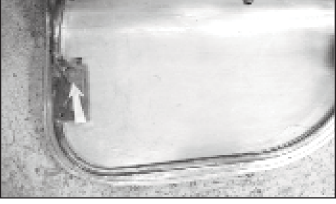
Each Cobra’s serial number was stamped in several places on the car. Additionally a plate was riveted to the passenger footbox on cars after CSX2200 (approx.). There are serial numbers stamped on the hood and trunk latches and on both door hinges. These were stamped at the factory as the pieces were being made because the hood, trunk or doors of each car were fitted to that car. During assembly it was helpful to identify which parts went on which car, especially if parts were unpainted or painted the same color.
Over the years, however, as some Cobras were wrecked or destroyed, some parts may have been scrapped or separated from the original car. Sometimes only a portion of the car remained – for example a hood, door or trunk lid. Someone finding one of those pieces in a junkyard might assume he had discovered all that existed of that particular car. But in fact, the rest of it (or a portion of the rest of it) might have been discovered in a different location by someone who also assumed that he had found all that was left of the car.
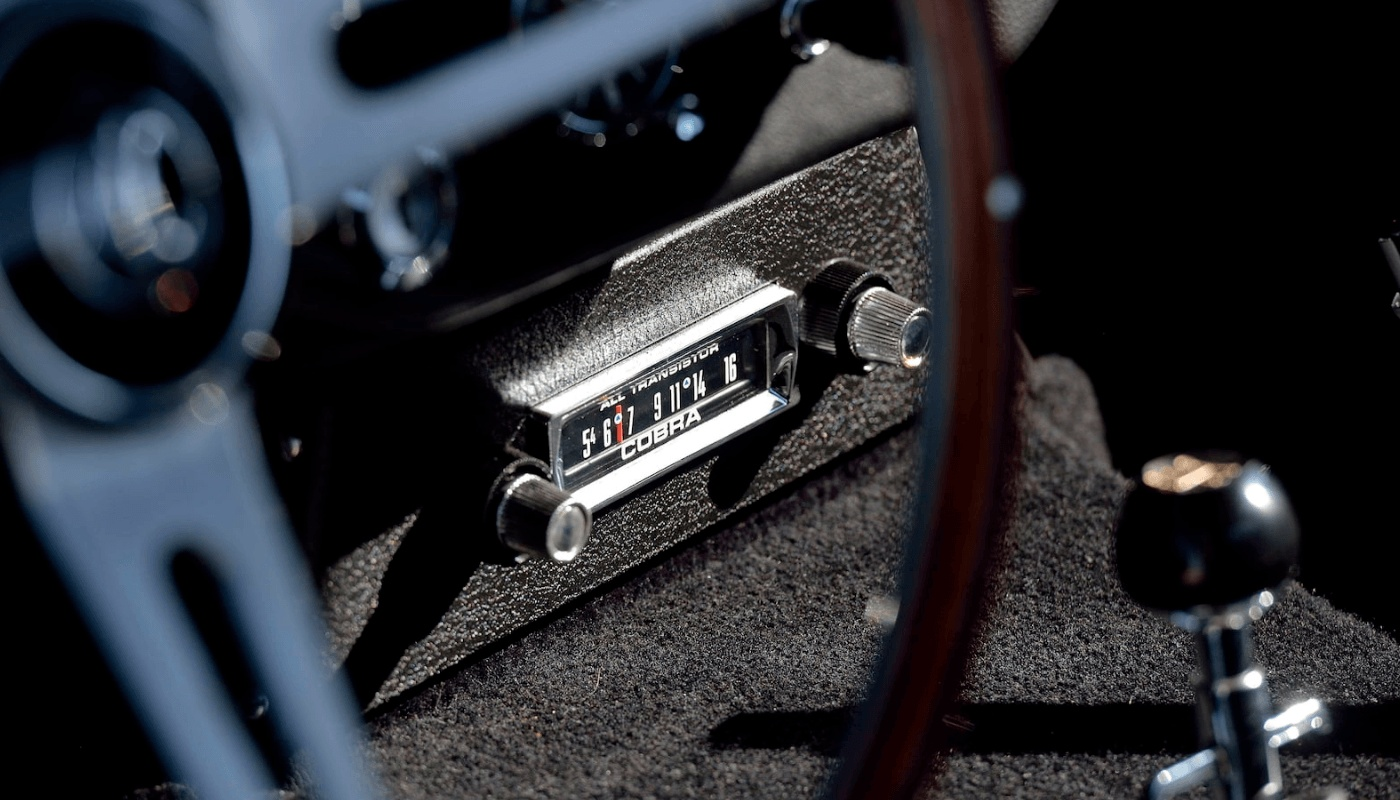
Ordering a radio in a Cobra roadster probably sounded like a great idea when the prospective buyer was
looking at the order form. But once the engine was singing, the exhaust snarling and the wind was whipping
through his hair it was probably the last thing that could be heard. The AM radio, made by Motorola but
carrying “Cobra” script on the face, was a $68.50 option. Installation included a face plate mounted to the
subframe uprights under the dashboard, a pair of speakers and an antenna mounted on the rear cowl, near the
upper right corner of the trunk lid (although when a dealer installed it, they pretty much put the antenna
wherever they wanted to).
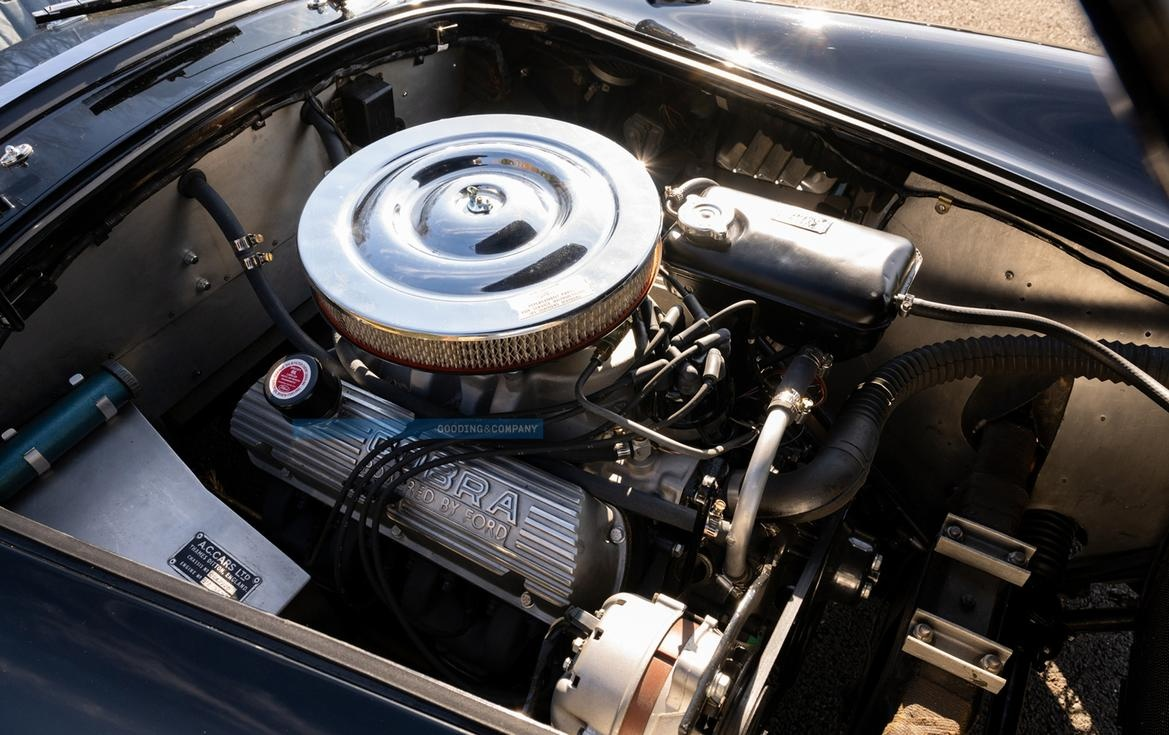
Early Cobra engine compartment [right], showing 260 cubic-inch V8 with cast-iron intake manifold and correct
Autolite carburetor. Aluminum hi-rise intake and 715 CFM Holley carburetor were optional on 289-equipped
cars.
possession of the title. The remains of the wreck were sold as salvage. Useable parts were stripped and what was left went to the crusher. The title was revoked and at that point that particular Cobra ceased to exist. The owner of a freshly created but numberless Cobra appropriates the serial number of the car which had been destroyed, and then begins creating a paper trail between the salvage yard and himself which will withstand scrutiny. Is this car the rightful possessor of that serial number? This is just one example of the kind of situation created when the value of a legitimate car rises to the point where it is worth more than the cost of its parts.
Something else worth considering is that the value of cars completely restored, where virtually every part has been redone or replaced in order to attain some level of super perfection, could be diminished in the future when compared to cars which are totally original but have some imperfections. The reason for this is because it may not be possible to distinguish restored but legitimate cars from newly created air cars other than by their serial numbers.
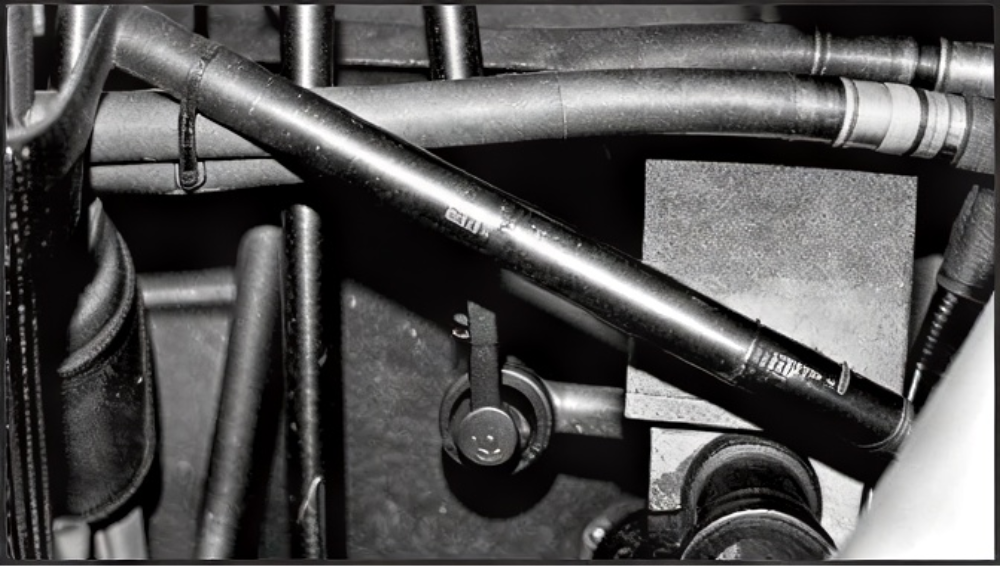
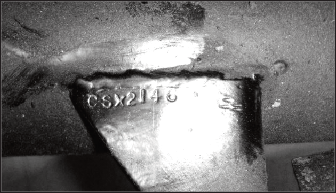
VEHICLE IDENTIFICATION NUMBER
LOCATION:
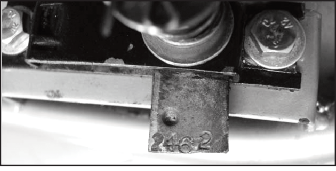
A. CHASSIS - WORM & SECTOR CARS: stamped into bracket above driver-side main frame rail, between steering box and bottom of fuel filter. Legible when leaning over driver- side front fender. A. CHASSIS - RACK & PINION CARS: stamped into passenger-side A-arm mounting bracket just above frame rail. Legible when leaning in engine compartment, over passenger-side fender (engine obscures line of sight). B. HOOD LATCH - numbers stamped into top of driver-side hood latch; visible when hood is open and latch is in locked position. C. TRUNK LATCH - stamped on trunk latch, facing inward; visible when trunk is open and latch is in locked position. D. DOOR HINGES - serial number (less prefix) stamped behind leather pocket on each door hinge, facing out. E. TRANSMISSION TUNNEL - handwritten with engraving tool on backside of metal panel that forms the transmission tunnel, usually on bottom side. F. TRUNK PANEL - handwritten with engraving tool on backside of metal panel separating passenger compartment from trunk compartment, on top section, facing trunk. G. FOOTBOX - serial number hand-stamped at AC Cars into silkscreened aluminum “AC CARS LTD” plate which was pop-riveted to passenger side footbox. Engine number hand-stamped at Shelby American when engine was installed. Used on cars 2170 (approx.) and higher. Not used on cars below 2170 (approx).
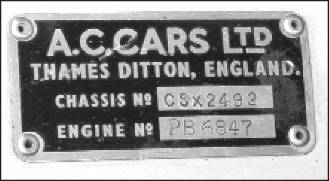
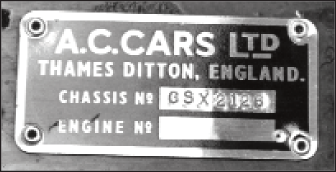
The aluminum serial number plate for CSX Cobras was stamped with the chassis number at AC Cars Ltd and riveted to the footbox during assembly. When the cars received their engines at Shelby American, the engine was given a four-digit engine number (usually but not always preceded by two letters: PA, PB or PC) and this was stamped into the serial number plate below the chassis number. This explains why a different set of number stamps were used. Also, since the plate was already riveted to the footbox, the engine number was not stamped as deeply into the tag because the footbox was fiberglass. Hitting the stamp hard with a hammer could damage the footbox.
The chassis/engine footbox tag was not used until approx. car # 2200. There was not one change-over car; some cars got the plate and some didn’t around that number. No early cars received these tags but when some owners of early cars thought their car’s tag was missing (even though their car had no evidence of having had holes drilled for one) they added a reprodction plate, leaving the engine number blank. They mistakenly thought that not having a plate would put their car’s authenticity in question when, in fact, just the opposite was the case. They gave their car something which it never originally had.
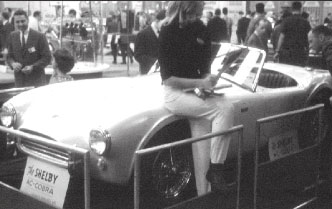
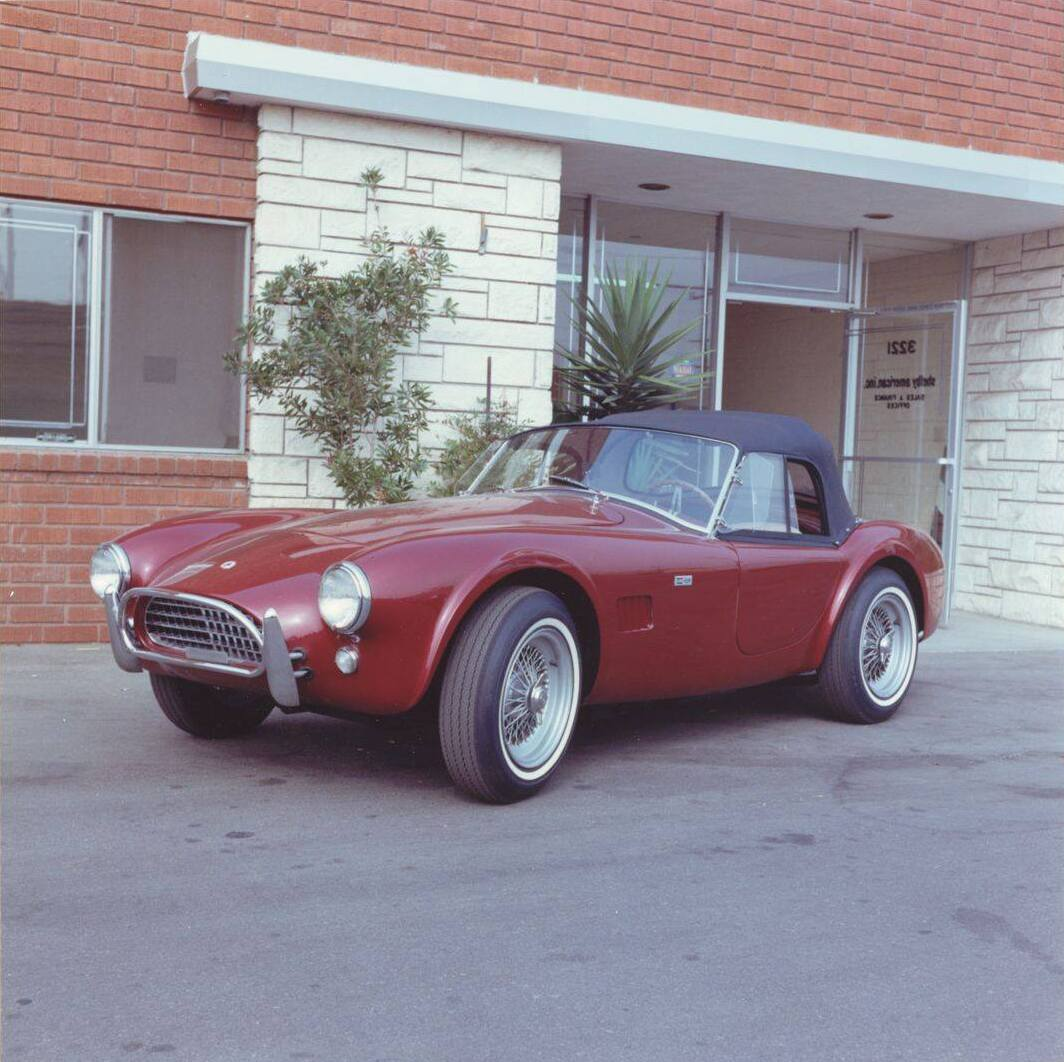
CSX2000 at the 1964 NY Automobile Show.
BREAKDOWN:CSX - C/Shelby/eXport - cars going to U.S.COB - CObra/Britain - cars built for sale in Great Britain; right-hand driveCOX - CObra/eXport - cars built for export to places other than U.S. or Great Britain; left-hand drive
2123 - consecutive production number, beginning with “2” (for leaf-spring cars). CSX car numbers begin with 2000 and end with 2589 (with the exception of two Daytona Coupes, 2601 and 2602). COB/COX car numbers begin with 6001 and end with 6062.