Once Carroll Shelby decides to do something, if the plan turns sour he doesn’t give up easily. As he’s been heard to say more than once, “Sometimes you have to make chicken salad out of chickenshit.” Take the 427 Cobra S/C completion cars, for instance. The 427 Cobra project began to take shape at the end of 1964. Ken Miles had experimented with a lightweight 390 engine (and later a 427) in a leaf spring chassis. The additional 100 horsepower pointed the direction for the new Cobra. That would be necessary because rumors were rampant that Chevrolet was toying with a lightweight version of the Stingray they were calling the Grand Sport. They were also trying to keep the wraps on a new 427 cubic-inch engine. It was a safe bet the 427 would eventually find its way into the Corvette, and that would make the small-block Cobra an instant back-marker. Ferrari was also building a new model—the 275LM (for “LeMans”). The engine was located behind the driver and the small block Cobras would have been no match for this car, either. Shelby knew all of this, and if he wanted to stay in the race he had to do something.
The original plan was to have AC Cars build 100 competition models (that number chosen because it was the minimum number required for a car to be accepted by the FIA for competition). As soon as the 100 cars (serial numbered CSX3001 through CSX3100) were completed, 427 Cobra street model production could begin. The two models would be different because everyone at Shelby American knew they would never sell more than 100 pure competition model Cobras. As it would turn out, there weren’t buyers for half that number.

CSX3062 was used for public relations photos before it was sold to a buyer in Japan.
By April of 1965, when FIA inspectors visited Ferrari S.p.A. and Shelby American, neither had the required 100
cars completed and FIA certification on both cars was withheld. Both manufacturers were forced to do battle for
1965 with what were essentially the previous year’s cars. Ferrari had finished only about 15 of the 275 LMs and
Shelby had 51 competition models sitting on the tarmac at his Los Angeles airport facility. A call immediately
went to AC Cars to cease building competition models and switch to street cars. AC began with CSX3101 and the
handful of unfinished competition chassis were used for various special projects. One became the 427 Super Coupe
(CSB3054), another (CSX3055) was sold to John Willment and used as the basis for a special coupe bodied car. A
third chassis (inexplicably numbered out of order—CSX3063) was extended 6˝ and delivered to Ghia coachbuilders
in Turin, Italy. It was used as the platform for a show car which Ford later evaluated as a potential Cobra
replacement.
Over the years that followed, rumors persisted that the “unused competition chassis” were in storage somewhere. No one ever admitted seeing these unused chassis, so it was only considered to be a rumor. However, those who knew how things worked at AC Cars remained extremely skeptical. AC’s Cobra production pipeline did not allow for large stockpiles of major components like completed (or even semi-completed) chassis. Had there been such a thing, each one would have been given a serial number and each of those numbers would have appeared on AC production records as well as invoices to Shelby American—because AC Cars would have wanted to get paid for their work. Had any chassis been shipped to Shelby American, shipping invoices and bills of lading would be in evidence, and none has ever been found. Nevertheless, the thought of 44 original 427 Cobra chassis, sitting in some dark warehouse acquiring a couple of decades worth of surface rust, made a compelling story which, once told, refused to die.
In 1981 Shelby had piqued the interest of the automotive world by building a dozen 1966 GT350 convertibles under the auspices of his company, Shelby American—the original manufacturer of the GT350. A little-known California law allowed a manufacturer to build past models to their original specifications and assign them a serial number in the original series. Some saw this as Shelby’s need to kick up some dust, just to let everyone know he was still around. Others saw it as naked opportunism. With prices of 1966 GT350 fastbacks in the $15,000 range, four newly minted convertibles were offered for sale at $44,000 each. They were immediately snapped up by collectors and enthusiasts, and the money they provided allowed a full dozen to be built. Four went to Shelby (he kept one and gave one to each of his three kids—then in their mid-thirties) and four went to his partner, J. Brunk of Beverly Hills Mustang, who handled their reconstruction. As was expected, the purists howled but Shelby weathered what turned out not to be a storm, but more like a brief drizzle. The automotive press reported about the cars with enthusiasm and SAAC took notice of everything, functioning not as reporters of the news but as historians gathering details for the future. The 1966 GT350 convertible “continuation cars” became a part of Shelby history. Whether Shelby used this project to test the waters to determine how continued Cobra production would be received can only be guessed at.
Shortly after the 1966 GT350 continuation convertible media blitz subsided, SAAC Director Rick Kopec received a phone call from Al Dowd, a long time Shelby employee who was, at that time, working as Shelby’s administrative assistant. Dowd matter-of-factly mentioned that, “the Old Man still has about 40 original 427 S/C chassis sitting in a warehouse in Texas, and he’s thinking about pulling them out and finishing them.” Kopec had been making several visits a year to Shelby’s Gardena offices ever since the SAAC convention in Pasadena, California in 1978. During that time he had developed an excellent relationship with Dowd and also with Lew Spencer, Shelby’s other long time employee, who was another of Shelby’s special assistants. Kopec and Dowd pulled no punches with each other. He told Dowd that he had heard that rumor and with it in mind, had looked very hard at AC Cars’ production records, copies of which he had obtained a few years earlier.
Kopec explained to Dowd that, “...this may be hard for you to believe—because you were there in 1965 when all this was happening—but there are people today who weren’t there but who know more about Cobra serial numbers and how they were recorded by AC Cars, and how the cars were produced and shipped to Shelby American than you or Shelby. I’m one of them. We have studied these records under a microscope and those 427 S/C serial numbers between 3056 and 3100 (with the exception of 3063) were never used. No chassis were built with those numbers stamped into them, and they were never exported to the U.S. It just did not happen. And if the Old Man tries to say it did so he can build these cars as originals, it won’t fly. He’s going to end up with egg on his face.” There wasn’t much for Dowd to say, and the subject was never brought up again.
Until 1991. By then the price of 427 Cobra S/Cs was topping $750,000 and buyers were going into feeding frenzies whenever one came on the market. Interest in Cobras was never greater and it had spawned an entire cottage industry of 427 Cobra kit car manufacturers. Demand for Cobra parts by those restoring the cars resulted in virtually everything either being reproduced or individually fabricated. Building a complete car from scratch was not only possible, but many were. Attempts to attach legitimate Cobra serial numbers to these “air cars” created a number of law suits with wronged parties claiming hundreds of thousands of dollars in damages.
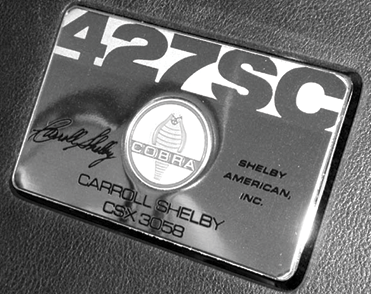
427 COBRA S/C COMPLETION CARS
The definition of an “original Cobra” is very specific. In addition to the obvious specifications and
physical dimensions, a car has to have been built by the original manufacturer—Shelby American—during the
original time frame—1962 to 1968. Without meeting both of those criteria, a car is not an original Cobra.
Even
Carroll Shelby can’t change that, as much as he would like to.
Shelby American, as a corporate entity, was in more or less continuous operation ever since the Los Angeles
airport facility was closed down in the fall of 1967. Occasionally it may have existed only on paper. This
being the case, it was possible for Shelby to resurrect that company when he wanted to manufacture (or more
accurately, “remanufacture”) 1966 GT350 convertibles in 1981. He did that again, in 1991, when he started
building 427 Cobra S/Cs again.
The Cobras made in 1992 are properly referred to as “completion cars” because they are completing a run of
serial numbers which started before them and continued after them. Had they picked up at the end of
production
and continuing from there (e.g. CSX3361, CSX3362, etc.) they would properly be called “continuation cars.”
They would be continuing where the originals left off. But they are not: they are plugging a hole in
production, as it were; completing the series—not continuing it.
Carroll Shelby stood above this maelstrom of activity, viewing it calmly. Ever since the Cobra ceased production he had harbored the desire to build another sports car—something which, when compared to the original 427 Cobra, would at least equal its performance and hopefully, even better it. Shelby knew that if he ever created another two-seat sports car, it would forever be measured against the 427 Cobra yardstick. In 1990 he received a heart transplant. He had been involved with the Viper in its very early stages. A little-known fact is that he built the first rough chassis prototype at his Shelby Automobiles, Inc. manufacturing facility in Santa Fe Springs, California in 1989. Once the project began to take shape, two things happened simultaneously. One was that the suits in the top-floor corner offices at Chrysler were seduced by the idea of having their own two-seat, high-performance sports car. The second was that Shelby’s failing health made it impossible for him to spend time in Detroit where he needed to be to represent his interests. So while he had his transplant and was recuperating in southern California, he watched the Viper slip from his grasp.
Now, in 1991, Shelby was looking at getting back into the sports car business again; only this time he would build a run of original specification 427 Cobra S/Cs. And he would give them the serial numbers which were never used in 1965 to legitimize them. When he leaked word of his intentions to several friends and acquaintances in the automotive press, hinting that the “missing” chassis existed and he still had them, the excitement it caused was like a tremor rippling across a desert floor. The reports immediately brought out skeptics and those who knew better. Whispers got louder and soon Shelby was being publicly challenged—something that had rarely happened in the past. With original 427 S/Cs selling for $750K, some people were questioning the coincidence of “why now?” The answer was, “follow the money.”
Two years earlier, in 1989, Shelby had quietly contacted Mike McCluskey, probably the best known Cobra restorer in the country (and arguably, the world) with the idea of building 427 Cobras. He asked McCluskey to draw up a list of everything necessary to manufacture a 427 Cobra S/C, and then find a source for each part. What could be purchased from original suppliers was. What needed to be manufactured was. And what had to be fabricated from raw materials was.
About the time he completed the first car in 1991 (numbered CSX3056 and left unpainted in raw aluminum like CSX2000 had been in 1961), McCluskey had also assembled a small warehouse containing 43 of everything needed to build a 427 Cobra S/C. The exceptions were the body panels (which could be fabricated as needed from sheet aluminum) and the engines and transmissions (which had to be purchased from individuals who specialized in selling used mechanical components). Shelby claimed to have found someone at Ford who knew where a half dozen brand new 427 blocks were squirreled away, and said he bought them. At the same time, he began laying the groundwork for another project: tooling up to reproduce 427 heads and blocks on his own.
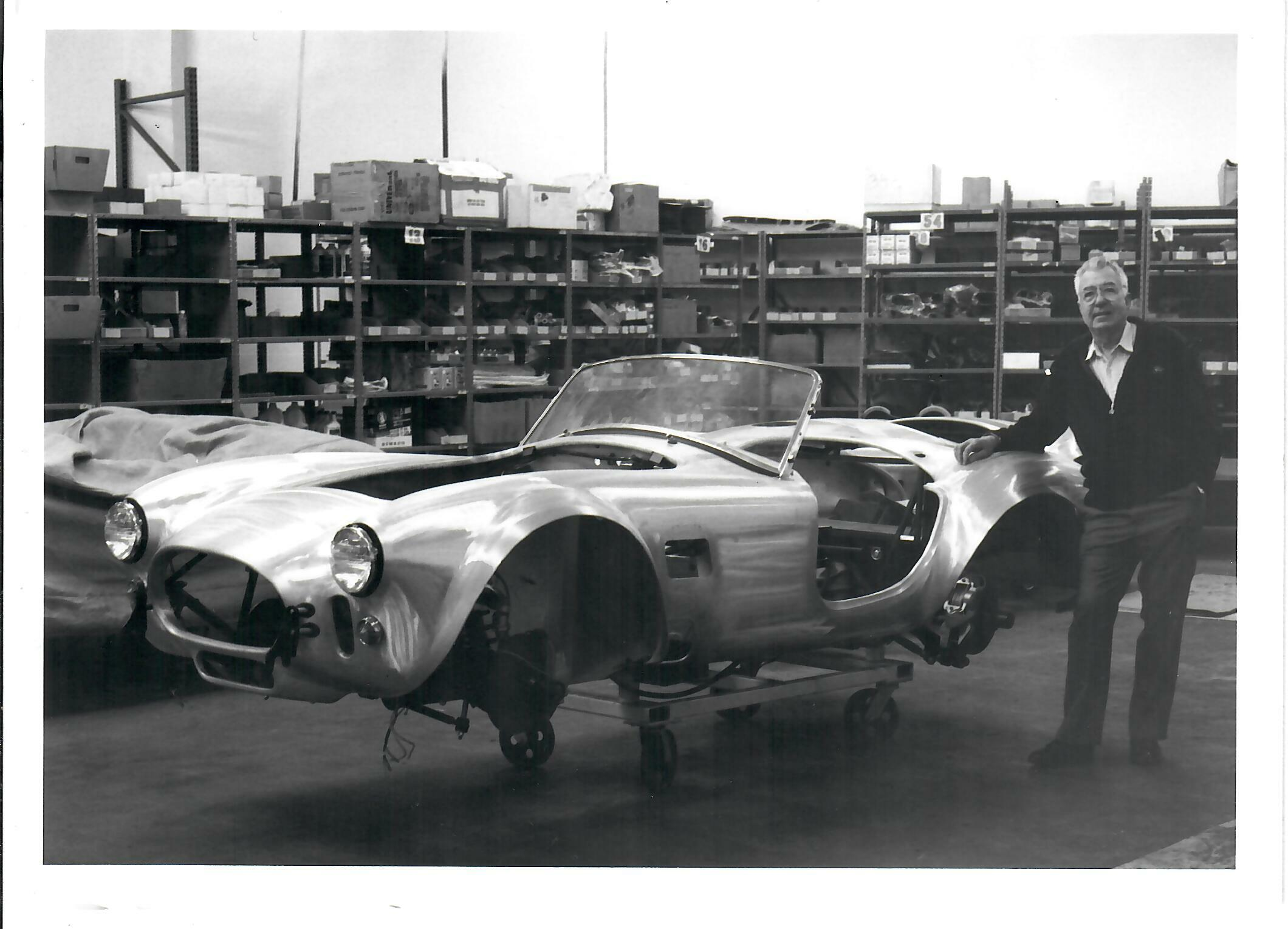
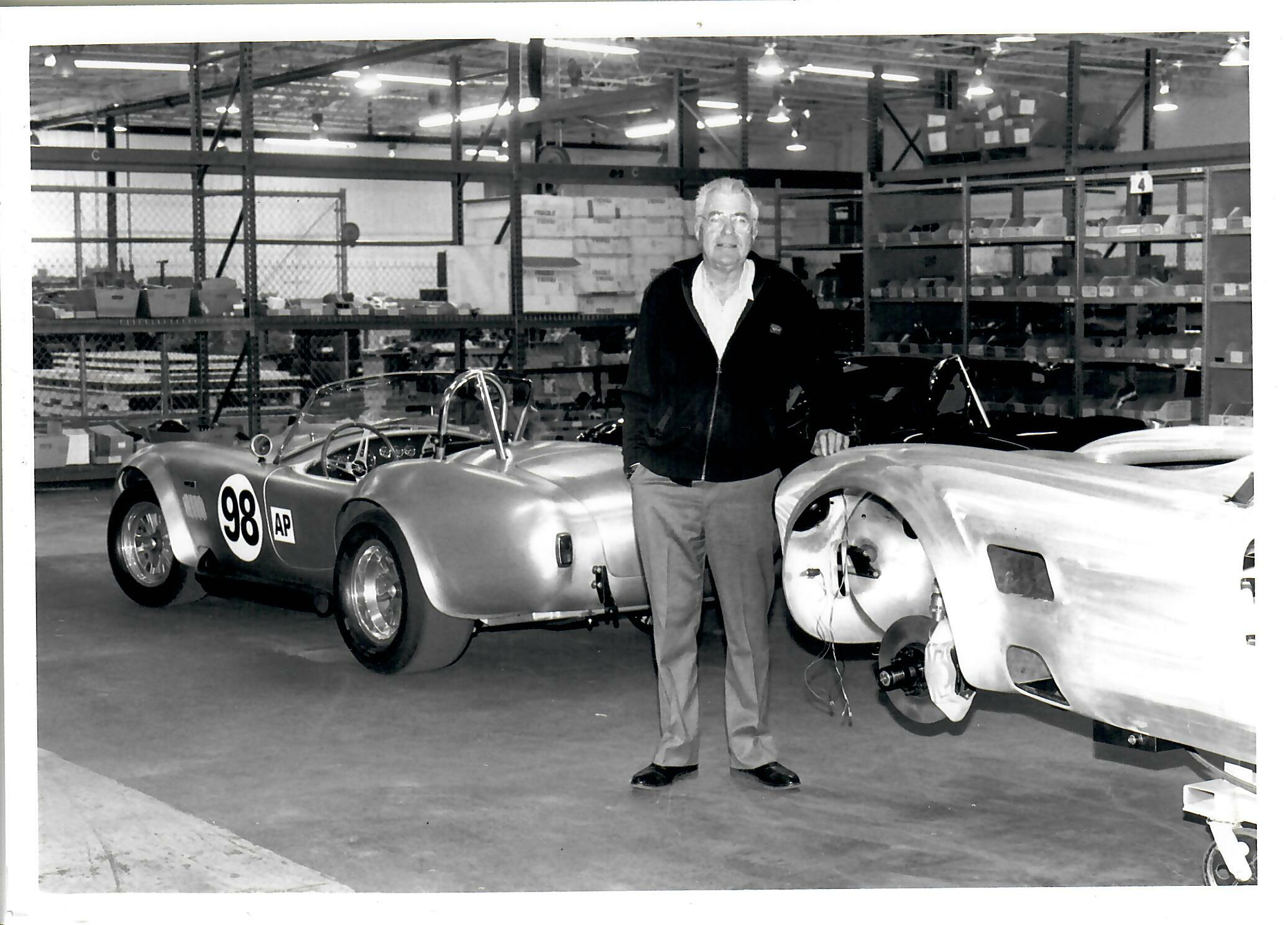
Mike McCluskey was contracted by Shelby to research sources for every part and component used to build a 427 S/C. Once the list was complete, McCluskey was directed to procure 44 of everything and then build a car. CSX3056 was the result. It was used to get publicity for the project, and that it did. The car seemed to be everywhere. The pump thus primed, a second car was started and Shelby waited for the salivating hoards to rush him waving blank checks. That never happened because by the time the cars could have been built, the market began its decline and suddenly Shelby’s completion cars were priced higher than original S/Cs.
Legendary promoter that he was, Shelby sat back and watched the action that followed the initial reports of almost 4 dozen long lost Cobra chassis resurfacing. The publicity was immediate, with most of the reports being somewhat skeptical yet polite; no one wished to hang the label of charlatan onto a national icon. Some questioned the logistics of how such a large number of chassis could have been secreted away for more than twenty-five years. During this time Brian Angliss, a Cobra restorer who had become a major stockholder in AC Cars and through that company was building his own “continuation” Cobra which he called the AC MK IV, became involved in what might politely be described as a major disagreement with Shelby. It escalated into a reported $60 million law suit, essentially over who had the right to build the Cobra and what they could call it. It was eventually settled out of court with both sides claiming victory.
In December of 1992, Paul Dean, an investigative reporter for the Los Angeles Times, contacted Shelby. He was working on a story which was eventually titled “A Donor With a Heart.” It ran in the January 28, 1993 edition and it described Shelby’s building of 427 Cobras and their link with his charity, The Shelby Heart Fund. Shelby claimed that proceeds from the sale of the cars would go to this charity. Dean spoke to dozens of people around Shelby and the resulting article portrayed him in a very positive light.
Two and-a-half months later, Dean sandbagged Shelby in a follow-up article. Using the good will created by his previous piece, the reporter spoke at length to a number of people about the 427 Cobra S/C project and gained their confidence. They later found their comments were used to cast Shelby in the worst possible light. The second article questioned Shelby’s right to give 44 cars 1965 serial numbers and use 1965 titles. It called into question Shelby’s integrity and offered quotes from several so-called (but unnamed) “experts” who maintained that these cars were little more than over-priced replicas. After interviewing representatives of the California Department of Motor Vehicles, Dean succeeded in getting them to initiate an investigation of Shelby. He then used the fact that Shelby was being investigated to allege potential wrong doing. In the end, Shelby was not allowed to use Manufacturers Statements of Origin to title the cars as original 1965 models (which would not have to conform to any federal or state motor vehicle requirements). Instead, they would have to be sold as competition vehicles, which could not be registered or driven on public roads. This winnowed out most buyers; it was hard to justify paying a half-a-million dollars for a car that could not be registered or legally driven on the road.
It was about this time that Shelby began to retrench. He phased out his Texas facility (where expanded Cobra production had, at one time, been envisioned) and moved everything back to California. But his sights were on Nevada. That state’s tax structure was much friendlier to small businesses and Nevada does not have a personal income tax. Shelby was offered the opportunity to become part of the newly planned Las Vegas Motor Speedway complex. He teamed up with Richie Clyne, director of the Imperial Palace Hotel and Casino’s automobile collection and the prime mover behind the new mega-speedway. Clyne had also developed an association with the Southern Desert Correctional Center, outside of Las Vegas. He helped establish an automotive restoration shop within the prison and used it to restore and maintain the casino’s large collection of vehicles. His actions were not totally civic-minded: he paid the prisoners in the shop only a small fraction of what it would cost to have the work done on the outside. In January of 1995, Shelby announced his move to Las Vegas. And, he said he would be using the prison and its “skilled” inmates to handle some of the work on his new 427 Cobra S/C completion cars.
Before any cars could actually be completed at the prison Shelby opened up a shop on the outskirts of downtown Las Vegas while he waited for his new facility to be finished out at the Speedway. That took the better part of two years. The main product was the newly announced CSX4000 series “Component Cobras.” Prospective buyers for the completion cars had evaporated, due to the double whammy of the drastic drop in Cobra values between 1991 and 1995 (from a high of $750,000 down to about $400,000) and also the difficulty in getting the new cars registered. Shelby initially refused to lower his $500,000 asking price, stating that he didn’t care if he sold any of the cars which remained to be built. But in January of 1997 he rolled the dice and placed one in the Kruse Auction in Scottsdale, Arizona. It was hammered sold at $420,000 and went to a buyer in Japan. Shelby took the new owner for a few laps around the Las Vegas track before handing over the keys.
As he had promised, the completion Cobras were only built after receipt of an order (along with a hefty deposit). Including the first one—Shelby’s own CSX3056—only eight have been built. Four found buyers in Japan, where the exchange rate was favorable and motor vehicle regulations were a little more lax for special cars such as these. A sixth car was given to his son, Pat, and the other two were purchased by buyers in Arizona. One is evidently suing Shelby because he claims he was not made aware that the car was not an original, 1965-built car as indicated on its paperwork. The outcome of that suit has, at last report, yet to be determined.
When the temporary Las Vegas shop was opened, all of the parts collected to produce the 427 completion cars were moved there. Shelby’s initial directive, that these parts be set aside and used only to build completion cars, remained in effect only so long. Cash flow was a perpetual problem in the early days of the CSX4000 program. Start-up costs are always high, and it was difficult for the project’s production manager to justify holding up CSX4000 cars for which deposits had been taken while waiting for pieces to be made when there was a storeroom in the back which held absolutely everything that was needed. It was a classical case of “robbing Peter to pay Paul” and by the time Shelby discovered some of the parts were missing there wasn’t much he could do about it. Eventually all of the parts were intermingled. As CSX4000 cars were completed it became obvious that the price differential between a CSX3000 completion Cobra and a CSX4000 Component Cobra—about $350,000—just about guaranteed that very few, if any, of the remaining 36 serial numbers would ever be completed. After all, aside from the serial number itself, they were the same car. So in the end, it was the CSX4000 that killed the 427 S/C completion cars. Even Shelby couldn’t sell a 3000 serial number for $350,000 more than a CSX4000.